FOLLOW US

Facebook  Twitter  RSS
Global

Resilience System

Oceans

19-Year-Old Develops Ocean Cleanup Array That Could Remove 7,250,000 Tons Of Plastic From the World's Oceans

inhabitat.com - March 26, 2013 - Timon Singh

The Ocean Cleanup Foundation, Ocean Cleanup Array, Boyan Slat, pacific garbage patch, garbage patch, plastic fibres, plastic foodchain, plastic recycling, TED, gyres


19-year-old Boyan Slat has unveiled plans to create an Ocean Cleanup Array that could remove 7,250,000 tons of plastic waste from the world’s oceans. The device consists of an anchored network of floating booms and processing platforms that could be dispatched to garbage patches around the world. Instead of moving through the ocean, the array would span the radius of a garbage patch, acting as a giant funnel. The angle of the booms would force plastic in the direction of the platforms, where it would be separated from plankton, filtered and stored for recycling.

Read entire article

BP and government lawyers prepare for battle over environmental cost of spill

The Deepwater Horizon blast led to 780m litres of oil escaping into the Gulf of Mexico, affecting wildlife such as pelicans. Photograph: Sean Gardner/Reuters

Image: The Deepwater Horizon blast led to 780m litres of oil escaping into the Gulf of Mexico, affecting wildlife such as pelicans. Photograph: Sean Gardner/Reuters

guardian.co.uk - February 22nd, 2013 - Dominic Rushe

Dolphin calving season has just begun in the Gulf of Mexico and marine biologists are reporting an alarming trend. Between 2000 and 2009, an average of 25 to 30 dolphins were found dead on the beaches of the Gulf each year. This year, 13 dead dolphins were found between 13 January and 14 February alone; 11 were aborted or newborns.

(VIEW COMPLETE ARTICLE)

Convention on International Trade in Endangered Species, March 3-14 2013, Bangkok, Thailand

CITES (the Convention on International Trade in Endangered Species of Wild Fauna and Flora, also known as the Washington Convention) will celebrate its 40th anniversary on March 3.  CITES currently has 176 parties and regulates international trade in about 30.000 endangered species of wild fauna and flora.  These species are listed in three different Appendices ( Appendix I, II and III ), according to the degree of protection they need.

Every three years, CITES hosts a meeting of the Conference of the Parties (CoP) to review its implementation and, if necessary, to amend the list of species in Appendices I and II.  The 16th Conference of the Parties will take place from March 3-14, 2013 in Bangkok, Thailand.

There will be great focus on the ocean at CoP16:

Coastal Resilience - Adapting Natural and Human Communities to Sea Level Rise and Coastal Hazards

Mounting evidence suggests that rising sea levels, coupled with related increases in storm surges, will increasingly put coastal populations at risk from inundation, storm damage, and saltwater intrusion. In order to adapt, decision-makers need access to information and tools that support choices for managing natural resources and protecting human communities.

Coastal Resilience provides a framework that supports decisions to reduce the ecological and socio-economic risks of coastal hazards.  Theframework includes 4 critical elements:

Radioactive Fish Found In California: Contamination From Fukushima Disaster Still Lingers


A fisherman displays his haul of Bluefin Tuna.

CLICK HERE: STUDY - Radiocesium in Pacific Bluefin Tuna Thunnus orientalis in 2012 Validates New Tracer Technique

huffingtonpost.com - by Aaron Sankin - February 22, 2013

Nearly two years after a powerful earthquake triggered a leak at Japan's Fukushima Dai-ichi nuclear plant, the effects of that disaster are still being felt on the other side of the planet.

A report released earlier this month by researchers at Stanford University's Hopkins Marine Station found that bluefin tuna caught just off the California coast tested positive for radiation stemming from the incident.

The study looked at the levels of radiocesium, one of the most common results of nuclear fission reactions, in Pacific Bluefun Tuna--largely as way to track the species' migratory patterns as the fish make their cross-oceanic journey in search of prey.

Overfishing Threatens Critical Link in the Food Chain

earth-policy.org - January 30th, 2013 - J. Matthew Roney

The fish near the bottom of the aquatic food chain are often overlooked, but they are vital to healthy oceans and estuaries. Collectively known as forage fish, these species—including sardines, anchovies, herrings, and shrimp-like crustaceans called krill—feed on plankton and become food themselves for larger fish, seabirds, and marine mammals. Historically, people have eaten many of these fish, too, of course. But as demand for animal protein has soared over the last half-century, more and more forage fish have been caught to feed livestock and farmed fish instead of being eaten by people directly.

(VIEW COMPLETE ARTICLE)


A Strong Message Sent from the Cabinet of the Maldives back in October 2009

See video

An underwater Cabinet Meeting in the Maldives drives home the point of the effects carbon emissions are having on our environment a sea levels rise.

The Great Barrier Reef Has Lost Half of its Coral in the Last 27 Years

Barnards after cyclone Larry. Image: AIMS Long-term Monitoring Team.

Australian Institute of Marine Science (AIMS)
October 2, 2012

Can we save the Reef by controlling crown of thorns starfish?

(ABSTRACT AND LINK TO STUDY - BELOW)

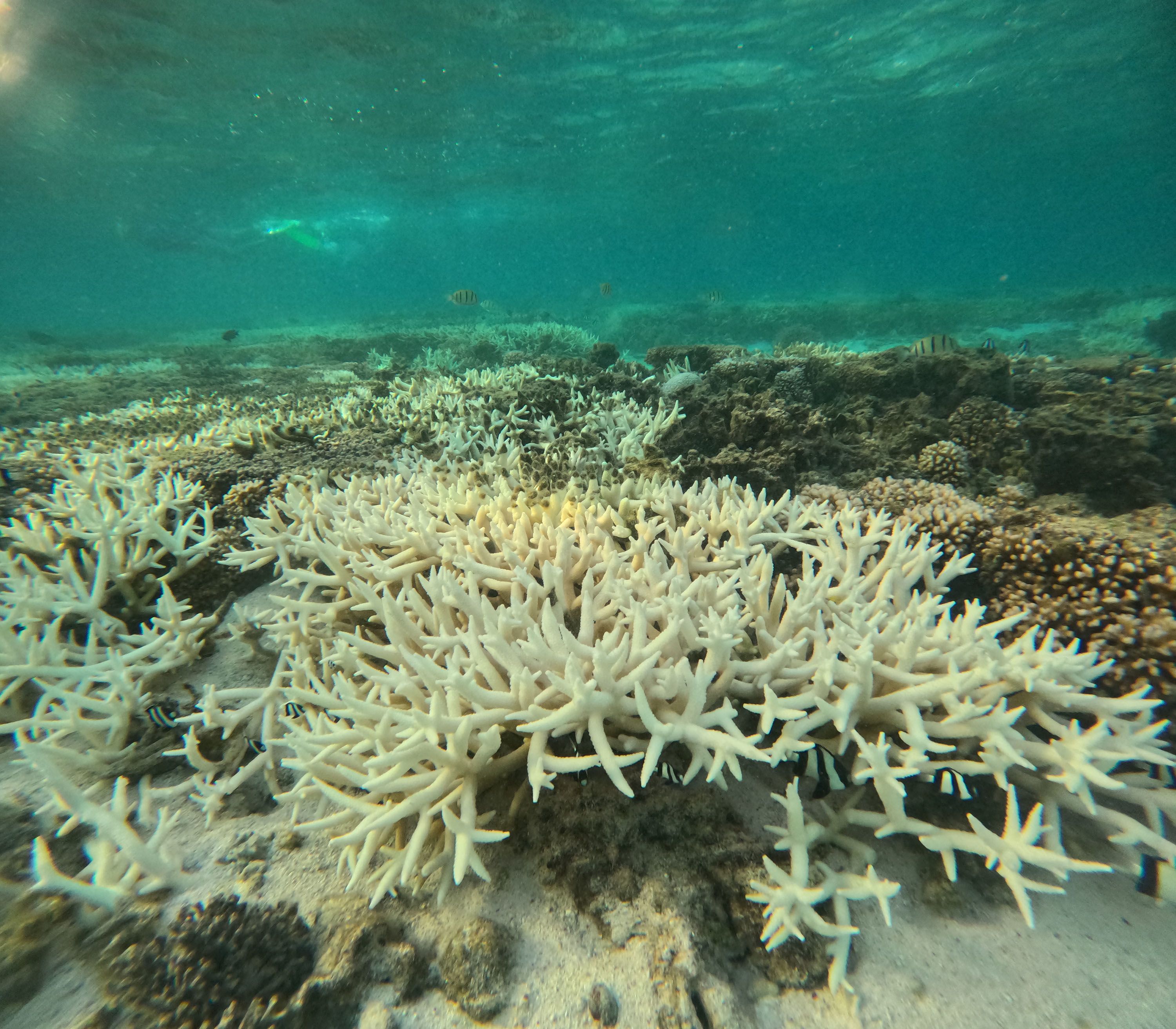
The Great Barrier Reef has lost half its coral cover in the last 27 years. The loss was due to storm damage (48%), crown of thorns starfish (42%), and bleaching (10%) according to a new study published in the Proceedings of the National Academy of Sciences today by researchers from the Australian Institute of Marine Science (AIMS) in Townsville and the University of Wollongong.

"We can't stop the storms but, perhaps we can stop the starfish. If we can, then the Reef will have more opportunity to adapt to the challenges of rising sea temperatures and ocean acidification", says John Gunn, CEO of AIMS.

Ocean-Based Food Security Threatened in a High CO2 World

oceana.org - September 24, 2012

Emissions from human activities are changing the ocean’s chemistry and temperature in ways that threaten the livelihoods of those who depend on fish and seafood for all or part of their diets. The changes may reduce the amount of wild caught seafood that can be supplied by the oceans and also redistribute species, changing the locations at which seafood can be caught and creating instability for ocean-based food security, or seafood security. This report ranks nations based on the seafood security hardships they may experience by the middle of this century due to changing ocean conditions from climate change and ocean acidification. This is done by combining each nation’s exposure to climate change and ocean acidification, its dependence on and consumption of fish and seafood and its level of adaptive capacity based on several socioeconomic factors. Country rankings are developed for risks from climate change and ocean acidification independently, as well as from both problems combined.

Climate Change Takes a Bite Out of Global Food Supply


A Pakistani fisherman talks with young boys. Rising ocean temperatures are pushing many fish away from the tropics towards the poles where waters are cooler. (Credit: Akbar Baloch/IPS)

commondreams.org - by Stephen Leahy - September 29, 2012

Humanity’s ability to feed itself is in serious doubt as climate change takes hold on land in the form of droughts and extreme weather, as well as on the world’s oceans.

Less well known to many is the fact that emissions from burning oil, coal and gas are both heating up the oceans and making them more acidic. That is combining to reduce the amount of seafood that can be caught, according to a new report released here.

(READ COMPLETE ARTICLE)

(SEE ADDITIONAL INFORMATION HERE - Ocean-Based Food Security Threatened in a High CO2 World)
http://resiliencesystem.org/ocean-based-food-security-threatened-high-co2-world

Syndicate content