

Video - Urban Resilience for a New Century
huffingtonpost.com - by Dr. Judith Rodin - May 14, 2013
The Rockefeller Foundation is today launching 100 Resilient Cities, a $100 million commitment to building urban resilience around the world. The Foundation's 100 Resilient Cities Centennial Challenge will select 100 cities through an application process to begin this summer. We will provide support for the winning cities to analyze the risks that will inform development of a city-wide resilient strategy, hire their first Chief Resilience Officer to drive its implementation and advice to leverage billions of additional dollars in infrastructure financing.
Rockefeller Foundation - 100 Resilient Cities Centennial Challenge
http://www.rockefellerfoundation.org/100-resilient-cities
Video - Scrap Fuel Subsidies and Price CO2, Urges World Bank
Reuters - trust.org - May 6, 2013
LONDON, May 6 (Reuters Point Carbon) – The world’s nations must scrap fossil fuel subsidies and put a price on emitting carbon dioxide if the planet is to avoid dangerous climate change, according to the president of the World Bank. The two measures are part of a five-point plan that the bank urged the world’s environment ministers to take, including building low carbon cities, improving agricultural practices and sharing new technology that will save energy.
“We need a global response equal to the scale of the climate problem.
Petersberg Climate Dialogue IV
http://www.bmu.de/en/topics/climate-energy/climate/international-climate-policy/petersberg-climate-dialogue/
Heat-Trapping Gas Passes Milestone, Raising Fears

The average carbon dioxide reading surpassed 400 parts per million at the research facility atop the Mauna Loa volcano on the island of Hawaii for the 24 hours that ended at 8 p.m. on Thursday. Chris Stewart/Associated Press
nytimes.com - by Justin Gillis - May 10, 2013
The level of the most important heat-trapping gas in the atmosphere, carbon dioxide, has passed a long-feared milestone, scientists reported Friday, reaching a concentration not seen on the earth for millions of years.
Scientific instruments showed that the gas had reached an average daily level above 400 parts per million — just an odometer moment in one sense, but also a sobering reminder that decades of efforts to bring human-produced emissions under control are faltering.
National Oceanic and Atmospheric Administration (NOAA) monitoring program
http://www.esrl.noaa.gov/gmd/ccgg/trends/weekly.html
Chinese Researchers Pinpoint Origins Of H7N9 Avian Flu

Chinese researchers have identified the origins of the novel H7N9 influenza virus
asianscientist.com - April 29, 2013
In March 2013, a novel H7N9 influenza virus was identified in China as the source of a flu-like disease in humans. A group of scientists, led by Professor Chen Hualan of the National Avian Influenza Reference Laboratory at the Harbin Veterinary Research Institute, investigated the origins of this novel H7N9 influenza virus.
“We suggest that strong measures, such as continued surveillance of avian and human hosts, control of animal movement, shutdown of live poultry markets, and culling of poultry in affected areas, should be taken during this initial stage of virus prevalence to prevent a possible pandemic. Additionally, it is also imperative to evaluate the pathogenicity and transmissibility of these H7N9 viruses, and to develop effective vaccines and antiviral drugs against so as to reduce their adverse effects upon human health,” say the authors.
Video - TIME, GOOGLE AND NASA: Timelapse of the Earth Over the Last 30 Years
world.time.com - by Jeffrey Kluger
Spacecraft and telescopes are not built by people interested in what’s going on at home. Rockets fly in one direction: up. Telescopes point in one direction: out. Of all the cosmic bodies studied in the long history of astronomy and space travel, the one that got the least attention was the one that ought to matter most to us—Earth.
That changed when NASA created the Landsat program, a series of satellites that would perpetually orbit our planet, looking not out but down. Surveillance spacecraft had done that before, of course, but they paid attention only to military or tactical sites. Landsat was a notable exception, built not for spycraft but for public monitoring of how the human species was altering the surface of the planet. Two generations, eight satellites and millions of pictures later, the space agency, along with the U.S. Geological Survey (USGS), has accumulated a stunning catalog of images that, when riffled through and stitched together, create a high-definition slide show of our rapidly changing Earth. TIME is proud to host the public unveiling of these images from orbit, which for the first time date all the way back to 1984.
Meet BRCK, a Backup Generator for the Internet

ushahidi.com - by Rob Baker - May 7, 2013
Ushahidi is a team of programmers and mappers who are constantly on the move.
Being constantly handicapped with spotty internet access has led us to realize that the way the entire world is connecting to the web is changing.
So Ushahidi set out to redesign the modem for the changing way we all connect to the web.
Enter BRCK: The easiest, most reliable way to connect to the Internet, anywhere in the world.
BRCK
http://www.kickstarter.com/projects/1776324009/brck-your-backup-generator-for-the-internet
Locust Plague Ravages Madagascar

A swarm of the Red Locusts passes through the Madagascar town of Sakaraha, on April 27, 2013 (AFP, Bilal Tarabey) Experts estimate there are currently 100 swarms across Madagascar, made up of about 500 billion ravenous locusts
submitted by Luis Kun
Agence-France Press (AFP) - by Gaelle Borgia - May 9, 2013
ANTANANARIVO — For three quarters of an hour a giant swarm of locusts streams across the sky above southwest Madagascar.
Along National Route Seven, normally an artery for tourists enjoying breathtaking views of the island's vast open spaces, a 15 kilometre long (nine mile) swarm clouds the sky.
Travellers today see little more than a natural disaster in progress -- a plague of locusts which has already destroyed half of the Indian Ocean island's crops.
Chapter 2. The Ecology of Population Growth - Full Planet, Empty Plates: The New Geopolitics of Food Scarcity
earth-policy.org
Full Planet, Empty Plates: The New Geopolitics of Food Scarcity
Chapter 2. The Ecology of Population Growth
by Lester R. Brown
Nearly two-thirds of Greek youths are unemployed

Image: A Greek unemployment center.
reuters.com - May 9th 2013 - George Georgiopoulos
Greek youth unemployment shot to a record 64 percent in February, underscoring the dire state of the recession-hit economy despite signs of improving business sentiment.
Repeated doses of austerity under international bailouts have almost tripled Greece's jobless rate since its debt crisis began in 2009, weighing on an economy in its sixth year of recession.
Overall unemployment has risen to an all-time high of 27 percent, data showed on Thursday, while joblessness in the 15-to-24 age group jumped to 64.2 percent in February from 59.3 percent in January.
The other-worldly philosophers

Image: Article illustration by Brett Ryder
economist.com - July 16th 2009
Robert Lucas, one of the greatest macroeconomists of his generation, and his followers are “making ancient and basic analytical errors all over the place”. Harvard's Robert Barro, another towering figure in the discipline, is “making truly boneheaded arguments”. The past 30 years of macroeconomics training at American and British universities were a “costly waste of time”.
(VIEW COMPLETE ARTICLE)
Crisis maps
voices.mckinseyonsociety.com - Patrick Meier
Crisis-mapping technology has emerged in the past five years as a tool to help humanitarian organizations deliver assistance to victims of civil conflicts and natural disasters. Crisis-mapping platforms display eyewitness reports submitted via e-mail, text message, and social media. The reports are then plotted on interactive maps, creating a geospatial record of events in real time.
(VIEW COMPLETE ARTICLE)
Bee Deaths: EU to Ban Neonicotinoid Pesticides

Honeybees are vital for pollinating crops - a job that would be very costly without them
bbc.co.uk - April 29, 2013
The European Commission will restrict the use of pesticides linked to bee deaths by researchers, despite a split among EU states on the issue.
There is great concern across Europe about the collapse of bee populations.
Neonicotinoid chemicals in pesticides are believed to harm bees and the European Commission says they should be restricted to crops not attractive to bees and other pollinators.
But many farmers and crop experts argue that there is insufficient data.
Global Warming Over Land Is Real: CU-Boulder, NOAA Study
huffingtonpost.com - by Charlie Brennan - April 12, 2013
(SEE LINK TO STUDY BELOW)
The thermometers got it right. The Earth is warming, another study is reporting.
Climate scientists recognize that changes in weather observation stations' immediate surroundings -- such as neighboring trees being replaced by heat-absorbing concrete -- can eventually throw data from such stations into question.
But now, a new study directed by a researcher at the National Oceanic and Atmospheric Administration that recreates climate history without the use of land-based observation systems shows the same thing that thermometers have been reporting.
"This shows that global warming over land is real," said Gilbert Compo, a scientist at NOAA's Cooperative Institute for Research in Environmental Sciences at the University of Colorado.
GRL - Independent confirmation of global land warming without the use of station temperatures
The Key to Running the World on Solar and Wind Power

Image: Chart of energy density per energy type
energytrendsinsider.com - April 30th, 2013 - Robert Rapier
Perhaps the biggest shortcoming of solar and wind power is their intermittency. In locations like Hawaii, where I live, wind and solar power are already competitive on price. My fossil-fuel supplied electricity typically costs above 40 cents a kilowatt-hour, and wind and solar power can compete with that. But since they can’t supply power that is available on demand (firm power) they must be backed up by power sources that can provide power when the sun isn’t shining and the wind isn’t blowing.
(VIEW COMPLETE ARTICLE)
Victory! Offshore Oil Drilling Stopped in Belize
Oceana.org April 17, 2013 Jessica Wiseman

Yesterday, Belize’s Supreme Court declared offshore drilling contracts issued by the Government of Belize (in 2004 and 2007) null and void, providing a dramatic and potentially definitive setback to The Government of Belize and the petroleum prospecting companies issued the contracts.
The ruling, handed down by Justice Oswell Legall, was in response to a case brought by Oceana, COLA, and the Belize Coalition to Save Our Natural Heritage. It effectively ends the Belizean government’s immediate effort to allow offshore oil drilling in the Meso American Reef, the second largest barrier reef in the world.
Millions Face Starvation as World Warms, Say Scientists

Corn in the hands of a farmworker in South Africa. Photograph: Greatstock Photographic Library/Alamy
guardian.co.uk - by John Vidal - April 13, 2013
Millions of people could become destitute in Africa and Asia as staple foods more than double in price by 2050 as a result of extreme temperatures, floods and droughts that will transform the way the world farms.
As food experts gather at two major conferences to discuss how to feed the nine billion people expected to be alive in 2050, leading scientists have told the Observer that food insecurity risks turning parts of Africa into permanent disaster areas. Rising temperatures will also have a drastic effect on access to basic foodstuffs, with potentially dire consequences for the poor.
US National Climate Assessment
http://assessment.globalchange.gov/what-we-do/assessment/draft-report-information
Crisis for Europe as trust hits record low
Image: The poll found a vertiginous decline in trust in the EU in countries that were traditionally pro-European. Photograph: Ian Waldie/Getty Images
guardian.co.uk - April 24th, 2013 - Ian Traynor
Public confidence in the European Union has fallen to historically low levels in the six biggest EU countries, raising fundamental questions about its democratic legitimacy more than three years into the union's worst ever crisis, new data shows.
After financial, currency and debt crises, wrenching budget and spending cuts, rich nations' bailouts of the poor, and surrenders of sovereign powers over policymaking to international technocrats, Euroscepticism is soaring to a degree that is likely to feed populist anti-EU politics and frustrate European leaders' efforts to arrest the collapse in support for their project.
The Limits of the Earth, Part 2: Expanding the Limits
Image: Limits of Earth logo.
blogs.scientificamerican.com - April 18th, 2013 - Ramez Naam
As part one of this series showed, we are up against incredible challenges: feeding a world with a rapidly growing appetite, the continuing loss of the world’s precious forests, the ongoing collapse of fish species in the oceans, the rapid depletion of our fresh water resources, and the over-arching threat of climate change, which makes all others far worse.
Ending growth isn’t a realistic option. Billions of people in the developing world want access to more resources, deserve those resources as much as those of us in the rich world do, and need them in order to rise out of poverty.
(VIEW COMPLETE ARTICLE)
The Limits of the Earth, Part 1: Problems
Image: Limits of Earth logo.
blogs.scientificamerican.com - April 17th, 2013 - Ramez Naam
The world is facing incredibly serious natural resource and environmental challenges: Climate change, fresh water depletion, ocean over-fishing, deforestation, air and water pollution, the struggle to feed a planet of billions.
All of these challenges are exacerbated by ever rising demand – over the next 40 years estimates are that demand for fresh water will rise 50%, demand for food will rise 70%, and demand for energy will nearly double – all in the same period that we need to tackle climate change, depletion of rivers and aquifers, and deforestation.
One view of these looming threats is that we’ve exhausted planet’s resources.
(VIEW COMPLETE ARTICLE)
Bike-Sharing Programs Hit the Streets in Over 500 Cities Worldwide
earth-policy.org - by Janet Larsen
April 25, 2013
Tomgram: Michael Klare, The Coming Global Explosion
tomdispatch.com - by Michael Klare - April 21, 2013
In his pathbreaking 2001 book Resource Wars, Michael Klare wrote: “Natural resources are the building blocks of civilization and an essential requirement of daily existence. The inhabitants of planet Earth have been blessed with a vast supply of most basic materials. But we are placing increased pressure on those supplies, and in some cases we face, in our lifetimes, or those of our children, the prospect of severe resource depletion.”
Dennis Meadows on 'The Limits to Growth and the Future of Humanity'
Image: Dennis Meadows
carsoncenter.uni-muenchen.de - December 4th, 2012
2012 marks the 40th anniversary of the publication of The Limits to Growth. Not only has this book been translated into more than 30 languages, it has also sold more than 30 million copies, thus making it the highest selling environmental book in world history. The Limits to Growth unleashed a debate that has yet to end.
(VIEW WEBSITE)
(VIEW PDF OF PRESENTATION)
The Grand Decade for Global Health: 1998–2008
chathamhouse.org - April 2013 - Jon Liden
The decade 1998-2008 was a period of rapid growth in the resources devoted to global health problems and of unprecedented innovation in the way these resources were delivered.
The innovation was principally manifested in new forms of partnerships which included in their governance the private sector, foundations and civil society alongside governments.
This institutional innovation was driven forward by dynamic new leadership at the World Health Organization under Dr Gro Harlem Brundtland and by political leaders in the G8 countries seeking to give globalization a human face, who were themselves heavily influenced by the moral and political force of AIDS activists and protestors.
(VIEW COMPLETE OVERVIEW)
(DOWNLOAD PAPER)
Full Planet, Empty Plates: The New Geopolitics of Food Scarcity
earth-policy.org
Full Planet, Empty Plates: The New Geopolitics of Food Scarcity
by Lester R. Brown
With food scarcity driven by falling water tables, eroding soils, and rising temperatures, control of arable land and water resources is moving to center stage in the global struggle for food security. “In this era of tightening world food supplies, the ability to grow food is fast becoming a new form of geopolitical leverage. Food is the new oil,” Lester R. Brown writes.
What will the geopolitics of food look like in a new era dominated by scarcity and food nationalism? Brown outlines the political implications of land acquisitions by grain-importing countries in Africa and elsewhere as well as the world’s shrinking buffers against poor harvests. With wisdom accumulated over decades of tracking agricultural issues, Brown exposes the increasingly volatile food situation the world is facing.
(SEE ADDITIONAL INFORMATION IN LINKS BELOW)
http://www.earth-policy.org/books/fpep
Chapter 1. Food: The Weak Link
http://www.earth-policy.org/books/fpep/fpepch1
Can You Have Too Much Solar Energy?

Image: A worker mounts solar panels on the roof of a barn in Binsham, Germany, in March 2012. (photo: Michaela Rehle/Reuters)
slate.com - March 29th, 2013 - Andrew Curry
It’s been a long, dark winter in Germany. In fact, there hasn’t been this little sun since people started tracking such things back in the early 1950s. Easter is around the corner, and the streets of Berlin are still covered in ice and snow. But spring will come, and when the snow finally melts, it will reveal the glossy black sheen of photovoltaic solar panels glinting from the North Sea to the Bavarian Alps.
(VIEW COMPLETE ARTICLE)
US Rice Imports Contain Harmful Levels of Lead

The researchers found the highest levels of lead in rice from China and Taiwan
submitted by Lloyd Helferty
bbc.co.uk - by Jason Palmer - April 10, 2013
Analysis of commercially available rice imported into the US has revealed it contains levels of lead far higher than regulations suggest are safe.
Some samples exceeded the "provisional total tolerable intake" (PTTI) set by the US Food and Drug Administration (FDA) by a factor of 120.
The report at the American Chemical Society Meeting adds to the already well-known issue of arsenic in rice.
Journal of Environmental Science and Health (Part B)
http://www.bbc.co.uk/news/science-environment-22099990
H7N9 Map
View H7N9 map in a larger map
Click on each balloon for more information on individual patients infected with the avian flu virus: blue, patients infected with the H7N9 virus under treatment; red, those infected with H7N9 who have died; and pink, those infect with the H1N1 avian flu virus.
http://www.scmp.com/news/hong-kong/article/1208847/hong-kong-standby-new-bird-flu-cases-revealed-shanghaiH7N9 Bird Flu

CLICK HERE - WHO - Global Alert and Response - Disease Outbreak News
CLICK HERE - ProMED-mail updates on H7N9 Bird Flu (Avian Influenza) - www.promedmail.org
ALSO SEE ADDITIONAL INFORMATION IN LINKS BELOW:
China reports nine bird flu cases amid allegations of cover up on social media
xinhuanet.com - China reports 2 more H7N9 bird flu cases
National Health and Family Planning Commission of the People's Republic of China
China's deadly new H7N9 bird flu virus may be harder to track than predecessors, scientists say
Is This a Pandemic Being Born?

foreignpolicy.com - by Laurie Garrett - April 1, 2013
China's mysterious pig, duck, and people deaths could be connected. And that should worry us.
Here's how it would happen. Children playing along an urban river bank would spot hundreds of grotesque, bloated pig carcasses bobbing downstream. Hundreds of miles away, angry citizens would protest the rising stench from piles of dead ducks and swans, their rotting bodies collecting by the thousands along river banks. And three unrelated individuals would stagger into three different hospitals, gasping for air. . .
. . . the facts delineated are all true, and have transpired over the last six weeks in China.
UN - World Food Programme - Hunger Map
(TO ENLARGE MAP - CLICK ON MAP IMAGE BELOW)
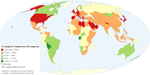
The map shows the prevalence of undernourishment in the total population as of 2010 - 2012. The indicator is an estimate of the percentage of the population having access to an amount of energy from food insufficient to maintain a healthy life.